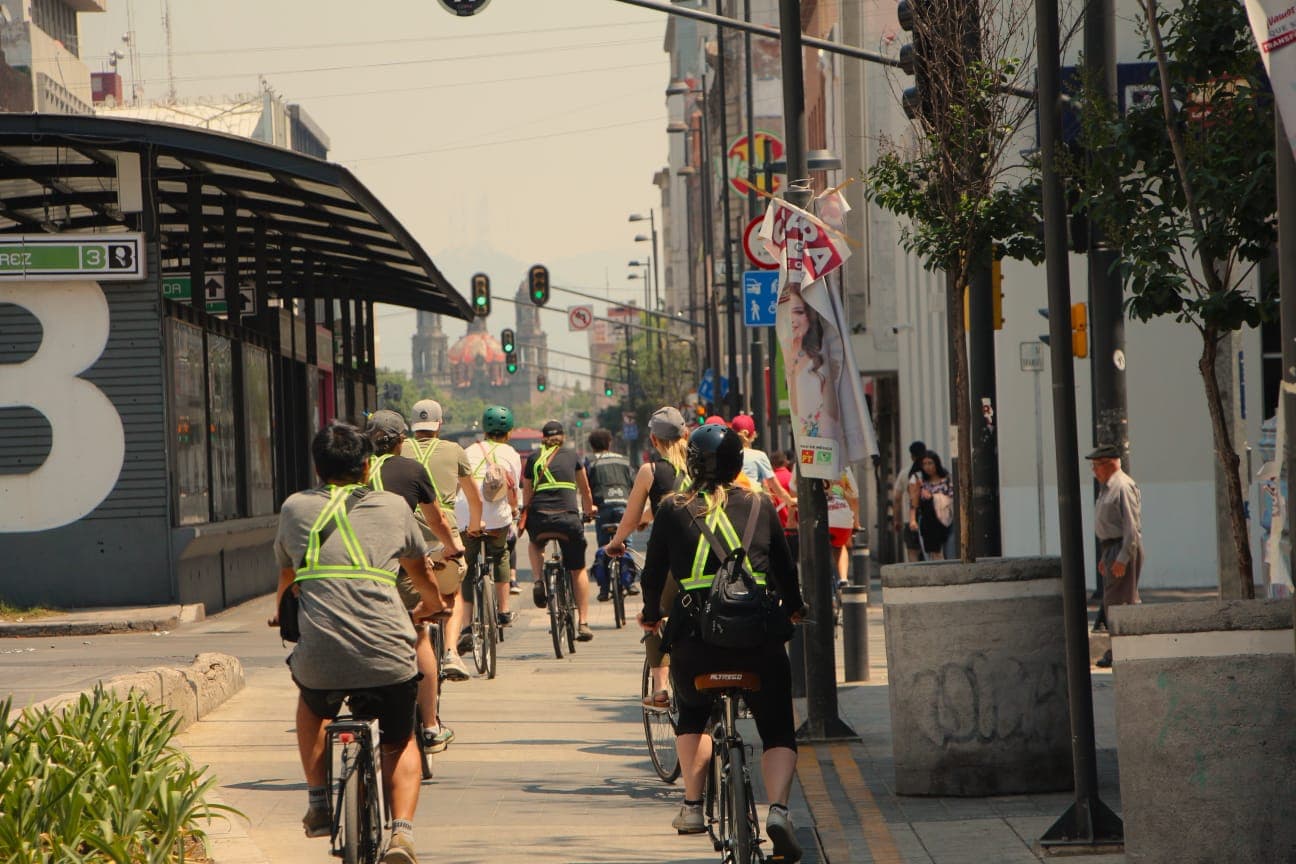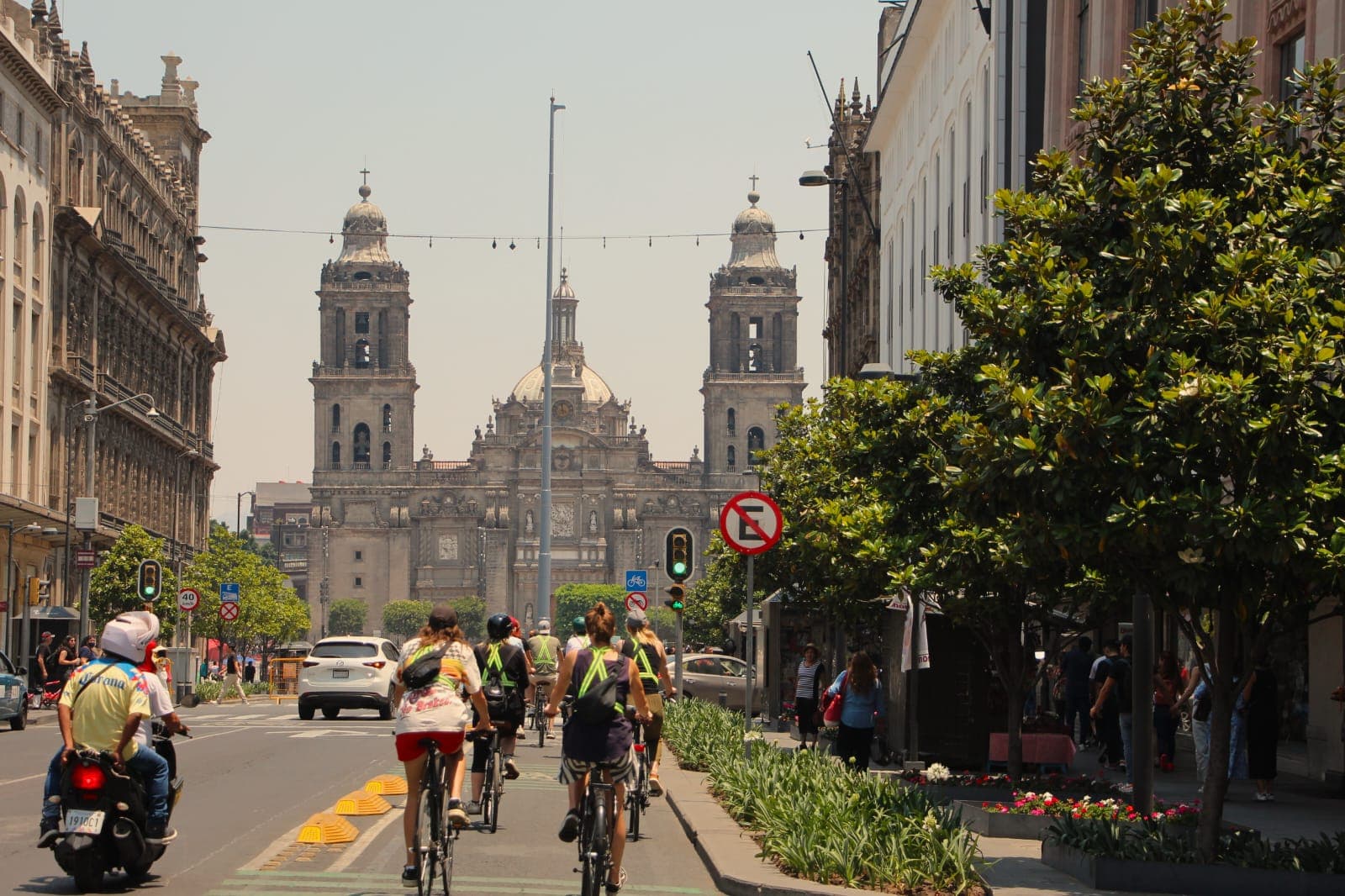
Every Sunday morning, Mexico City shuts down 55 to 61 kilometers of major roads and hands them over to cyclists, runners, and skaters. No cars. No buses. Just open pavement from 8 AM to 2 PM. In 2025, a record 4.4 million people participated across the year, with a single-day peak of 160,566 riders on August 10 (Excelsior, 2025).
The program is called Muévete en Bici — literally "Move by Bike" — and it's one of the best free things you can do in Mexico City. We've been riding it every week with our bike tour groups for over three years, and we still look forward to Sunday mornings.
This guide covers everything a visitor needs to know: how the route works, where to get a bike, what to bring, how to handle the altitude, and what to do after the ride. We wrote it because every existing English-language guide was written by someone who visited once. We ride this route professionally, every week, year-round.
Key Takeaways
Muévete en Bici closes 55–61 km of Mexico City streets to cars every Sunday, 8 AM – 2 PM, attracting an average of 21,812 participants weekly (PMC/NIH, 2019). You don't need your own bike — free government loaners, Ecobici bike-share ($123 MXN/day), and private rentals are all available. Arrive before 9 AM to beat crowds, bring sunscreen and water, and give yourself a day to acclimatize to the 2,240-meter altitude before riding hard. The first three Sundays each month run the standard Paseo Dominical route; the fourth Sunday is the longer Ciclotón (60–97 km).
What Is Muévete en Bici?
Muévete en Bici is Mexico City's weekly car-free cycling program. Launched on May 13, 2007, it closes major avenues to motor vehicles every Sunday so people can bike, walk, skate, or run on open roads. A peer-reviewed study published in the PMC/NIH database found an average of 21,812 participants per Sunday, with 88.5% of them cycling (PMC/NIH, 2019). The program runs rain or shine, year-round, and it's completely free.
The route spans six boroughs — Cuauhtémoc, Miguel Hidalgo, Benito Juárez, Coyoacán, Gustavo A. Madero, and Venustiano Carranza — covering 55 to 61 km of car-free streets each Sunday. The backbone is Paseo de la Reforma, the grand boulevard that cuts diagonally through the city center past the Angel of Independence, the Diana the Huntress fountain, and Chapultepec Park.
Here's how the schedule works:
- First three Sundays: Paseo Dominical — the standard 55 km route along Reforma and connecting avenues
- Fourth Sunday: Ciclotón — an expanded version covering 60 to 97 km with additional road closures and extended routes into neighborhoods not on the regular circuit
- Hours: 8 AM to 2 PM every Sunday
- Cost: Free. Always has been.
The gender split is nearly even — 51.3% women, 48.7% men — which says something about how safe the ride feels on the ground (PMC/NIH, 2019).
Our observation: After three years of Sunday rides, the crowd density follows a clear pattern. Before 9 AM, you'll share the road with serious cyclists doing speed laps and a few early families. By 10:30 AM, the route between the Angel and Chapultepec is packed. If you want photos without hundreds of people in them, start at 8.
What Does the Route Look Like?
The main Muévete en Bici route runs along Paseo de la Reforma, Mexico City's most iconic boulevard. In 2023, the city had 380.7 km of dedicated bike lanes, ranking second in Latin America behind Bogotá's 593 km (Mexico Business News, 2023). On Sundays, though, you don't need bike lanes — you get entire avenues.
Riding west from the Zócalo toward Chapultepec, here's what you'll pass:
Key landmarks along Reforma
Key Landmarks Along Reforma
- Glorieta de la Palma — The starting point for many riders. This is also where free government bikes are available.
- The Angel of Independence — Mexico's most photographed monument. Expect crowds here after 10 AM, but early morning the roundabout is empty and gorgeous.
- Diana the Huntress Fountain — A bronze sculpture in the middle of Reforma's glorieta. Good rest stop with shade nearby.
- Chapultepec Castle — Visible from the road as you approach the park entrance. The hill up to the castle itself isn't part of the bike route, but you can lock up and walk.
- Auditorio Nacional — Mexico's premier concert venue marks the western end of the core Reforma stretch.
Beyond Reforma
The route extends well past Reforma into connecting avenues. You can ride south through Condesa and Roma on closed streets, or head north toward Tlatelolco. The Ciclotón (fourth Sunday) extends even further — reaching neighborhoods like Xochimilco or Iztapalapa on some editions.
Insider tip: The stretch between the Angel and Chapultepec gets the most traffic. If you want a quieter ride, head southeast from Glorieta de la Palma toward Avenida Juárez and the Alameda Central. Fewer riders, more shade, and you'll pass the Palacio de Bellas Artes.
How Do You Get a Bike for the Sunday Ride?
1. CDMX Tours Bike Rentals
We rent comfortable hybrid bikes by the hour or day from our shop. No membership, no app, no 45-minute limit. Just show up, pick a bike, and ride. Check our bike rental options for current pricing.
Pros: Flexible rental periods. Hybrid bikes with gears (helpful on the few inclines). Helmets and locks included. We also offer Bike tours!
2. Ecobici Bike-Share
Ecobici has 9,300+ bikes across 689 docking stations throughout the city. Tourist passes are available: one day for $123 MXN, three days for $245 MXN, or seven days for $409 MXN. You sign up through the Ecobici app on your phone.
Pros: Stations everywhere — you can dock and re-dock along the route. Affordable. Bikes are decent quality with baskets.
Cons: Each ride is limited to 45 minutes before overage charges. You'll need to re-dock every 45 minutes, which interrupts the flow. The sign-up process requires a Mexican phone number or credit card and can be finicky for international visitors.
3. Free Government Bikes at Glorieta de la Palma
The city government sets up a free bike loan station at Glorieta de la Palma on Reforma every Sunday morning. You leave a valid ID (passport or Mexican INE) as deposit and get a basic bike for up to two hours.
Pros: Free. Can't beat that.
Cons: Limited quantity. They can run out by 9:30 AM on busy Sundays. Bikes are heavy single-speeds with no gears. Two-hour limit means you can't ride the full route. You must return to the same spot.
4. Bring Your Own
If you're staying in CDMX for a while and bought or borrowed a bike, ride it. The route is well-marked and policed. Just bring a lock if you plan to stop.
Mexico City's Ecobici system is planning to expand to 15,000 bikes in 2026 and 20,000 by 2027, so the bike-share option is only getting better (Mexico Business News, 2026).
How Does Altitude Affect Cycling in Mexico City?
Mexico City sits at 2,240 meters (7,350 feet) above sea level, where the air contains roughly 25% less oxygen than at sea level. If you flew in yesterday, you'll feel it on the bike. A peer-reviewed study confirmed that the average participant is cycling for recreation, not racing, which helps — 88.5% of Muévete en Bici participants are on bikes, riding at a comfortable pace (PMC/NIH, 2019).
What to Expect
Your heart rate will be higher than normal for the same level of effort. Hills that would feel easy at sea level will leave you breathing hard. Most people adjust within 48 to 72 hours of arrival.
Our Altitude Advice
After running bike tours at altitude for three years, here's what we've learned:
- Give yourself one full day in the city before riding. If you arrived Saturday, ride Sunday but take it easy. Don't try to keep up with local cyclists — they're acclimatized.
- Drink more water than feels necessary. Dehydration hits faster at altitude. We recommend at least a liter before you even get on the bike.
- Slow down. The ride isn't a race. Pace yourself, especially in the first 30 minutes.
- Skip the mezcal the night before. Altitude amplifies hangovers. A lot.
- Eat breakfast. Something with carbs and protein. A tamal and coffee from a street vendor works perfectly.
The ride is flat along Reforma, which helps. You won't encounter serious inclines unless you venture off the main route into neighborhoods like Condesa's hillier western edge.
What's the Difference Between Paseo Dominical and Ciclotón?
The Paseo Dominical runs the first three Sundays of each month along the standard 55 km route. The Ciclotón, held on the fourth Sunday, expands the route to 60–97 km by closing additional roads and extending into neighborhoods not normally covered (Wikipedia).
The standard 55 km route along Reforma. Best for first-timers, families, and casual riders. More food vendors and activity stations.
Expanded 60–97 km route reaching neighborhoods like Iztapalapa and Xochimilco. Faster pace, longer distances, fewer vendors.
Paseo Dominical (First Three Sundays)
- 55–61 km of closed roads
- Centered on Paseo de la Reforma
- Best for first-timers, families, and casual riders
- More food vendors and activity stations along the route
- Typically 20,000–80,000 participants
Ciclotón (Fourth Sunday)
- 60–97 km of closed roads
- Extended routes reaching neighborhoods like Iztapalapa, Tlalpan, or Xochimilco
- More serious cycling crowd — faster pace, longer distances
- Fewer casual riders and vendors on the extended sections
- Great if you want to see parts of the city tourists rarely visit
Both run 8 AM to 2 PM. If it's your first time, we recommend a Paseo Dominical Sunday. You'll get the full Reforma experience with more fellow riders, more food stops, and a more festive atmosphere. Save the Ciclotón for your second visit — or if you're an experienced cyclist who wants real distance.
What About Riding at Night? The Paseo Nocturno
Mexico City also runs a nighttime version called the Paseo Nocturno, typically on the last Saturday of each month. In 2025, the Day of the Dead Nocturnal Paseo on November 1 drew 190,282 participants — the largest nighttime ride on record (Expansión, 2025).
The night ride starts later (usually 8–9 PM) and follows a different route than the Sunday ride. It's a different vibe entirely — festive, louder, with music blasting from portable speakers strapped to bikes. If you're in CDMX on the right Saturday, it's worth checking the Muévete en Bici social media accounts for the date and route.
You'll need bike lights for the night ride. Most rental shops don't provide them, so plan ahead or buy a cheap clip-on LED set at a Chedraui or OXXO for under $100 MXN.
Frequently Asked Questions
Is Muévete en Bici free?
Yes, completely free. The road closures, police presence, first aid stations, and even the government bike loan program at Glorieta de la Palma are all funded by the city. You'll only spend money if you rent a bike from a private company or buy food from vendors along the route.
What time should I arrive?
We recommend arriving at the route between 8:00 and 8:30 AM. The roads open at 8 AM and close at 2 PM. Arriving early gives you the quietest riding conditions and first pick of the free government bikes (which run out by 9:30 AM on busy days). Peak crowd time is 10 AM – 12 PM.
Do I need a helmet?
Helmets aren't legally required for adults in Mexico City, but we strongly recommend wearing one. Most private bike rental shops include helmets at no extra charge. Ecobici bikes and free government bikes don't come with helmets.
Can I ride Muévete en Bici with kids?
Absolutely. The Sunday ride is one of the most family-friendly activities in the city. Many families ride together, and the closed roads mean no car traffic. Kids should ride on the right side of the road, and parents should stay on the traffic side. Smaller children can ride in child seats or trailers — you'll see dozens of them every Sunday.
Does Muévete en Bici happen when it rains?
Yes. The ride runs rain or shine, every Sunday. Mexico City's rainy season (June through October) brings afternoon showers, but mornings are usually clear. If it's raining at 8 AM, expect a smaller crowd and a surprisingly pleasant ride — just bring a light rain jacket.
How far do I have to ride?
As far as you want. There's no required distance or route you must complete. Many people ride just 5–10 km of the Reforma stretch and stop for food. Serious cyclists do the full 55 km loop. On Ciclotón Sundays, the route extends up to 97 km.
Can I walk or run instead of cycling?
Yes. About 11.5% of Muévete en Bici participants walk, run, or skate instead of cycling (PMC/NIH, 2019). Runners and walkers should stick to the right side of the road. Skaters are common too, and dedicated skating groups often show up with music.
Where can I park a car if I'm driving to the route?
Street parking is available in neighborhoods adjacent to the route — try side streets in Juárez, Cuauhtémoc, or near Chapultepec. However, some streets are blocked for the event, so plan to park a few blocks away. Many riders take the Metro to Chapultepec, Sevilla, or Insurgentes stations — all on Line 1 — and walk to the route.
Plan Your Sunday Ride
Muévete en Bici is the best free thing to do in Mexico City on a Sunday. Whether you rent a bike, borrow one, or bring your own, you'll be riding some of the city's grandest avenues without a car in sight. Arrive early, bring sunscreen and water, take it easy at altitude, and don't skip the tacos afterward.
We ride this route every week. If you'd rather ride with a guide who knows the route, the history, and the best places to stop, check out our Mexico City bike tours or grab a bike rental and ride it yourself.
Coming Up in This Series
- Muévete en Bici Route Map: Every Landmark Along the Way — A visual guide to the full route with photos and GPS coordinates
- What to Bring to Muévete en Bici: The Tourist Checklist — An expanded packing list with gear recommendations
- Is Muévete en Bici Safe? A Local Guide's Honest Answer — Deep dive into safety data and practical precautions
- Ciclotón CDMX: The Extended Sunday Bike Ride (Up to 97 km) — Everything about the fourth-Sunday expanded ride
- Mexico City's Night Bike Ride: Paseo Nocturno Guide — The after-dark version you didn't know existed
- Your Perfect Mexico City Sunday: Bike Ride + What to Do After — A full-day itinerary built around the morning ride
CDMX Tours operates bike tours, walking tours, and bike rentals in Mexico City. We've been riding Muévete en Bici every Sunday since 2023. Questions? Get in touch.